
If you've reached the stage of keeping reading glasses in every room, you've probably noticed the problem: they're great for a page or a phone, but the moment you look up, everything blurs. Multi-focus — or progressive — readers are designed to solve exactly that.
Why we need readers in the first place
From around our early 40s, the natural lens inside the eye gradually becomes less flexible. This is called presbyopia, and it makes focusing on close objects harder. It happens to almost everyone and is the reason "arms getting too short" is such a common joke.
Single-vision readers
Standard readers have one magnifying strength across the whole lens. They work well for one distance — usually reading — but blur everything else.
Bifocals
Bifocals have two distinct zones separated by a visible line: one for distance and one for reading. The jump between zones can be noticeable, and there's no zone for middle distances like a computer screen.
Progressive multi-focus readers
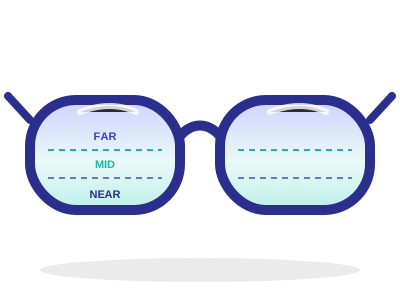
Progressive lenses change strength gradually from the top of the lens to the bottom, with no visible line:
- Top: little or no magnification, for looking across the room.
- Middle: moderate magnification for screens and dashboards at arm's length.
- Bottom: full reader strength for books, phones and labels.
Who they suit best
Progressive readers like ViShift Pro are ideal if you have presbyopia, don't need prescription correction for distance, and switch between near and far frequently during the day.
Who should see an optometrist first
If you have astigmatism, a significant distance prescription, different needs in each eye, or any sudden change in vision, see an eye-care professional. Non-prescription readers are a convenience product, not a medical device to correct those conditions.
Try ViShift Pro
30-day money-back guarantee · Secure checkout · Ships in 1–2 business days
See prices →